
ClinicalBERT
Clinical language understanding.
ClinicalBERT support helps the system interpret clinical language, population details, intervention terms, and outcome signals with more precision.
EBPcharlie
EBPcharlie helps clinicians search PubMed, shape PICO, score trust, and turn research into something you can actually use.
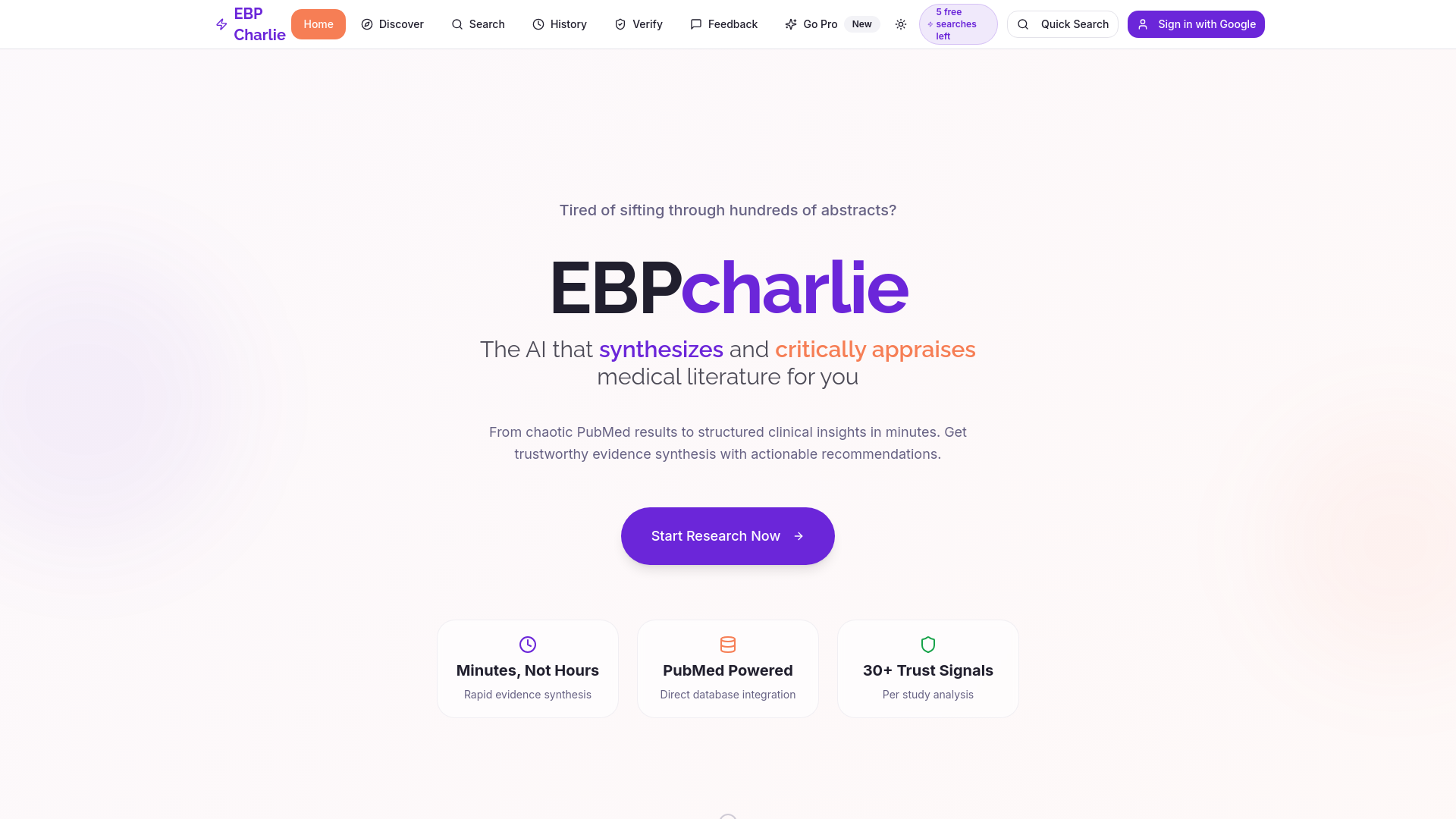
EBPcharlie live preview
Search, discover, history, trust score, recommendation output, podcast generation, and a cleaner route from question to evidence.
Evidence flow
The problem
Clinicians still jump between PubMed tabs, abstracts, notes, and ad hoc quality judgments. The result is familiar: too many results, too little structure, and too much pressure on the final call.
EBPcharlie compresses that workflow into a clearer path. Ask one question. Retrieve the literature. Score trust. Synthesize. Then act with more context and less friction.
It is not trying to replace evidence-based practice. It is trying to make it easier to use well.
EBPcharlie 2.0
The newer layer brings ClinicalBERT support, real-time PICO extraction, clinical scoring, advanced quality assessment, podcast output, and a PWA workflow into the same research surface.
ClinicalBERT
ClinicalBERT support helps the system interpret clinical language, population details, intervention terms, and outcome signals with more precision.
Quality
Bias detection, study design classification, and methodology checks help separate stronger evidence from weaker signals.
Clinical scoring
The scoring layer considers whether the evidence is usable for real clinical decisions, not only whether it looks strong on paper.
Accuracy
The product interface presents a high accuracy target for supported clinical analysis flows. The evidence trail remains visible so users can still inspect the reasoning.
How it works
This is the core product logic: one clinical question becomes a structured evidence answer with the trust signals still visible.
Ask
EBPcharlie starts where real work starts: a clinical question that can be shaped into PICO before anything else happens.
Search
The search layer is built for clinical questions, PICO logic, publication filters, and relevance, not generic keyword guessing.
Score
Instead of hiding behind one answer, EBPcharlie shows the signals behind it: study type, venue, method, sample quality, bias, and relevance.
Synthesize
The output becomes a recommendation, summary, limitations view, and implementation guide instead of a wall of abstracts.
Act
The final step is not blind automation. It is a clearer recommendation with source context, scoring logic, and uncertainty still visible.
Enhanced clinical search
The analysis form supports a clinical question, flexible PICO requirements, ClinicalBERT analysis, publication type filters, professional background, and date ranges. The point is to shape the search before the evidence is scored.
Real-time PICO analysis shows completeness across population, intervention, comparison, and outcome, so the user can improve the question before relying on the result.
Core features
The point is not to flood the screen with more data. The point is to make the evidence legible enough to use and transparent enough to trust.
Search
Searches are built for clinical questions, PICO structure, publication filters, and evidence retrieval. This is the front door.
Trust
Venue vetting, manuscript triage, and deeper content checks are combined into one readable trust layer that stays auditable.
Question logic
Population, intervention, comparison, and outcome are identified in real time so the question stays clinically useful.
Hierarchy
Systematic reviews, randomized trials, cohort studies, and weaker study types are separated so the user can scan quality quickly.
Synthesis
The answer is shaped around what matters in practice, not around abstract summaries alone. It stays useful without pretending certainty.
Statistics
Effect sizes, heterogeneity, and decision-useful signals such as NNT or NNH can be surfaced when the evidence needs a deeper pass.
Scoring
The system looks at real-world applicability, not only publication strength, so the output is easier to use in practice.
Implementation
The output can separate immediate use, secondary consideration, and longer-term interpretation instead of treating every finding the same way.
Limits
EBPcharlie does not only tell you what looks strong. It also shows where evidence is thin, mixed, or not ready for action.
Verification
The verification layer reduces bad references, broken claims, and stitched-together source errors. Trust has to be earned in the open.
Audit depth
When a paper matters, the system can go beyond summary and inspect quality, bias, and weak points more carefully.
Compass
Instead of a closed score, the user gets a clearer sense of how strong, consistent, and clinically usable the evidence is.
Output
Research output can be turned into shareable documents or podcast-style audio so clinicians and students can review findings in a different format.
App access
EBPcharlie can be installed for quicker access, a cleaner research workflow, and a more focused entry point than a browser tab.
Outputs
EBPcharlie is not only a search page. It is a research workflow that can turn the same evidence base into a structured review, a recommendation, a score layer, and an audio learning format.
Synthesis
The output brings search results, trust signals, hierarchy, limitations, and recommendations into one readable flow.
Podcast
Research findings can be converted into an audio format for review, teaching, or clinical learning without losing the evidence structure.
Voices
The podcast layer is designed to feel like a professional clinical discussion, not a flat reading of a summary.
Feedback
Ratings and comments help improve search quality, trust assessments, interface clarity, and the features clinicians actually need.
Glass box transparency
EBPcharlie should not hide behind a single summary score. The whole point is that users can inspect the hierarchy, the signals, and the context that shaped the recommendation.
That is the difference between a clinical evidence system and a glossy answer engine. If the trust layer cannot be audited, it should not be trusted.
This is also what separates EBPcharlie from a normal manual review and from lighter search tools. The goal is not only retrieval. The goal is structured scrutiny.
Research verification layer
EBPcharlie is the product surface. Nagomi is closer to the command-line research layer: search PubMed, structure the question, verify references, inspect a paper, and export the trail.
That matters because evidence work should not only produce an answer. It should leave enough structure behind to check the answer.
View NagomiExample use
/nagomi:search chronic low back pain exercise
/nagomi:verify references.pdf
/nagomi:analyze 34580864
Premium depth
The premium layer is not meant to feel like a separate product. It is there for the moments when the abstract-level pass is not enough.
Premium
Deeper methodology checks, bias detection, and richer explanation when abstract-level review is not enough.
Premium
Institutional signals, author credibility, and citation patterns add another layer when the question needs stronger scrutiny.
Premium
The premium layer is meant to feel like stronger scrutiny, not a separate product. It goes deeper where the evidence is messy.
Who it is for
Clinicians
People who need a faster route from question to a structured evidence answer without losing the evidence trail.
Researchers
The system compresses retrieval, hierarchy, and trust signals so more time can go into the harder interpretive work.
Students
EBPcharlie helps make evidence appraisal less abstract by showing why one source or recommendation deserves more trust than another.
Technical architecture
Under the surface, EBPcharlie is shaped around clinical language models, PubMed retrieval, Semantic Scholar context, PICO structure, trust assessment, and a product layer that keeps the research flow usable instead of overwhelming.
Ready when you are
Built for clinicians, researchers, and students who want a faster answer without losing the evidence trail.